IC 1396 - Elephant's Trunk Nebula: Revealing What Is Really There
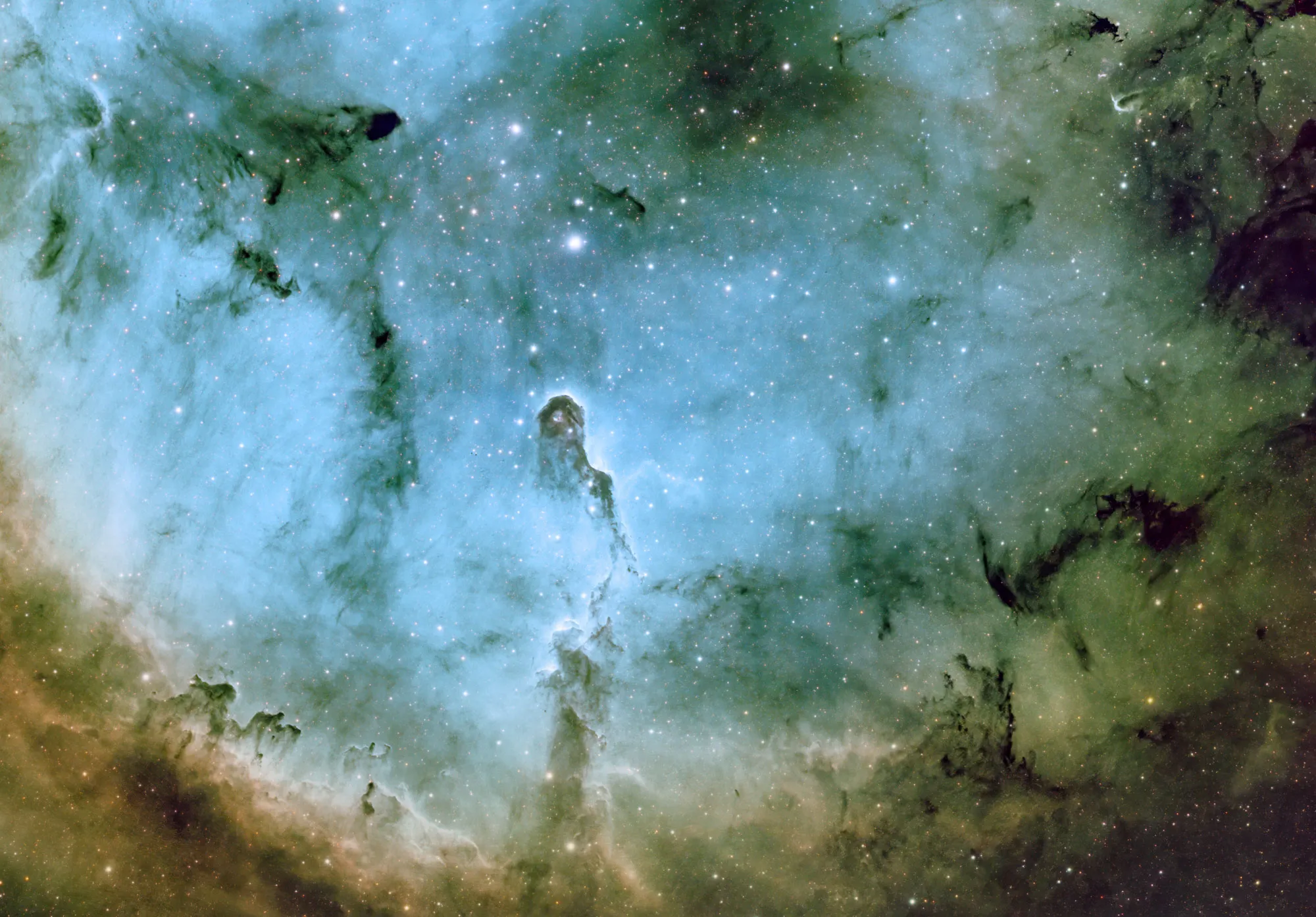
The Elephant’s Trunk Nebula is an emission nebula in the constellation Cepheus. To find the location of this deep-sky object, look toward the Garnet Star (Mu Cephei). The astrophotographers and details below showcases the image I captured from my rural backyard using Chroma narrowband filters with a high-end 4" refracting telescope and a medium format camera.
I have photographed a lot of objects over the years, but IC 1396 is one of those regions that keeps giving you reasons to go back. Most people know it because of the Elephant’s Trunk, but the trunk is only one part of a much larger structure. Once you collect enough good data, the rest of the region begins to tell its own story.
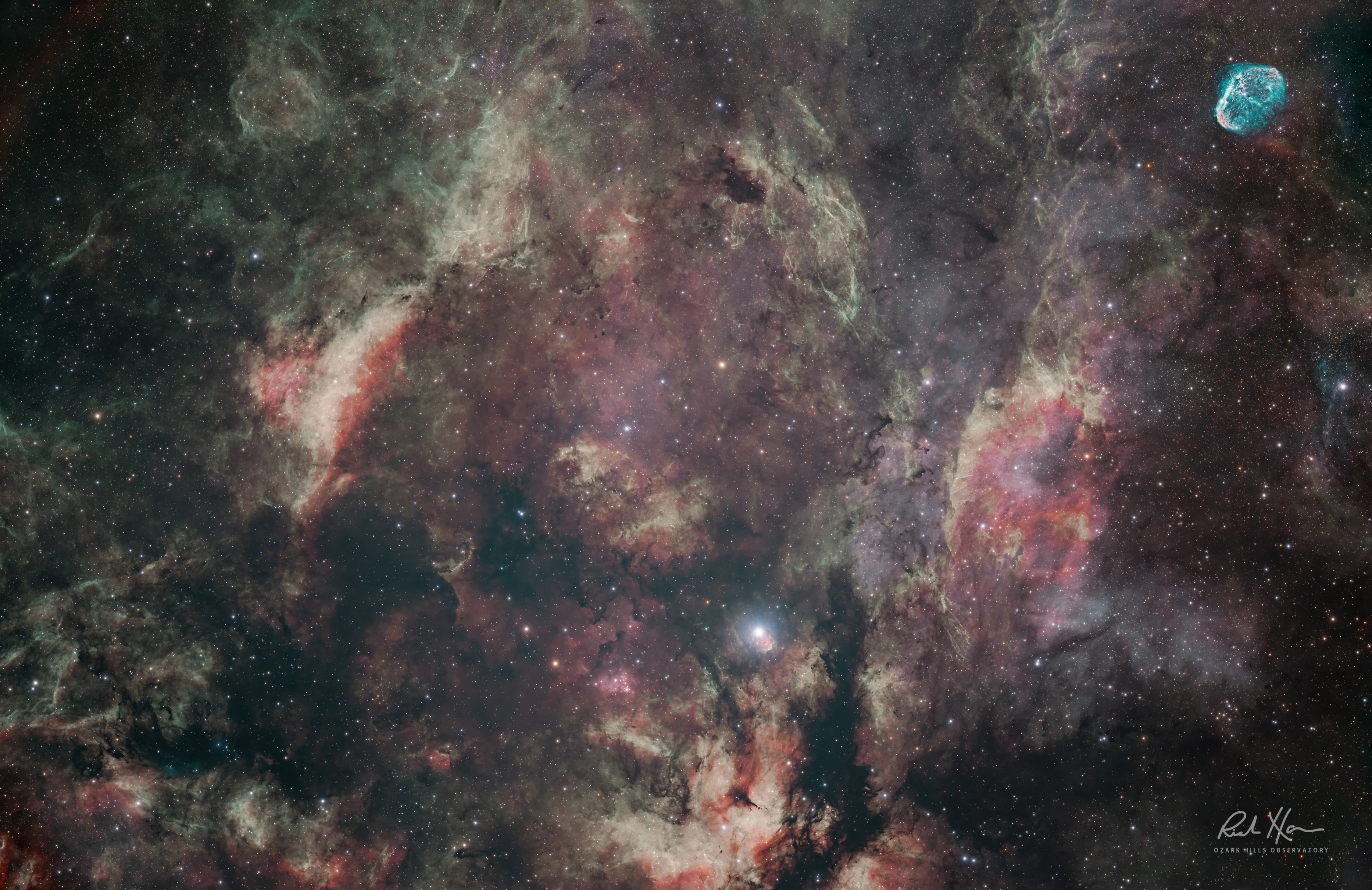
The photo below shows just how much there actually is in this region of the sky. With a wide enough field and extremely high resolution, you can capture it all.
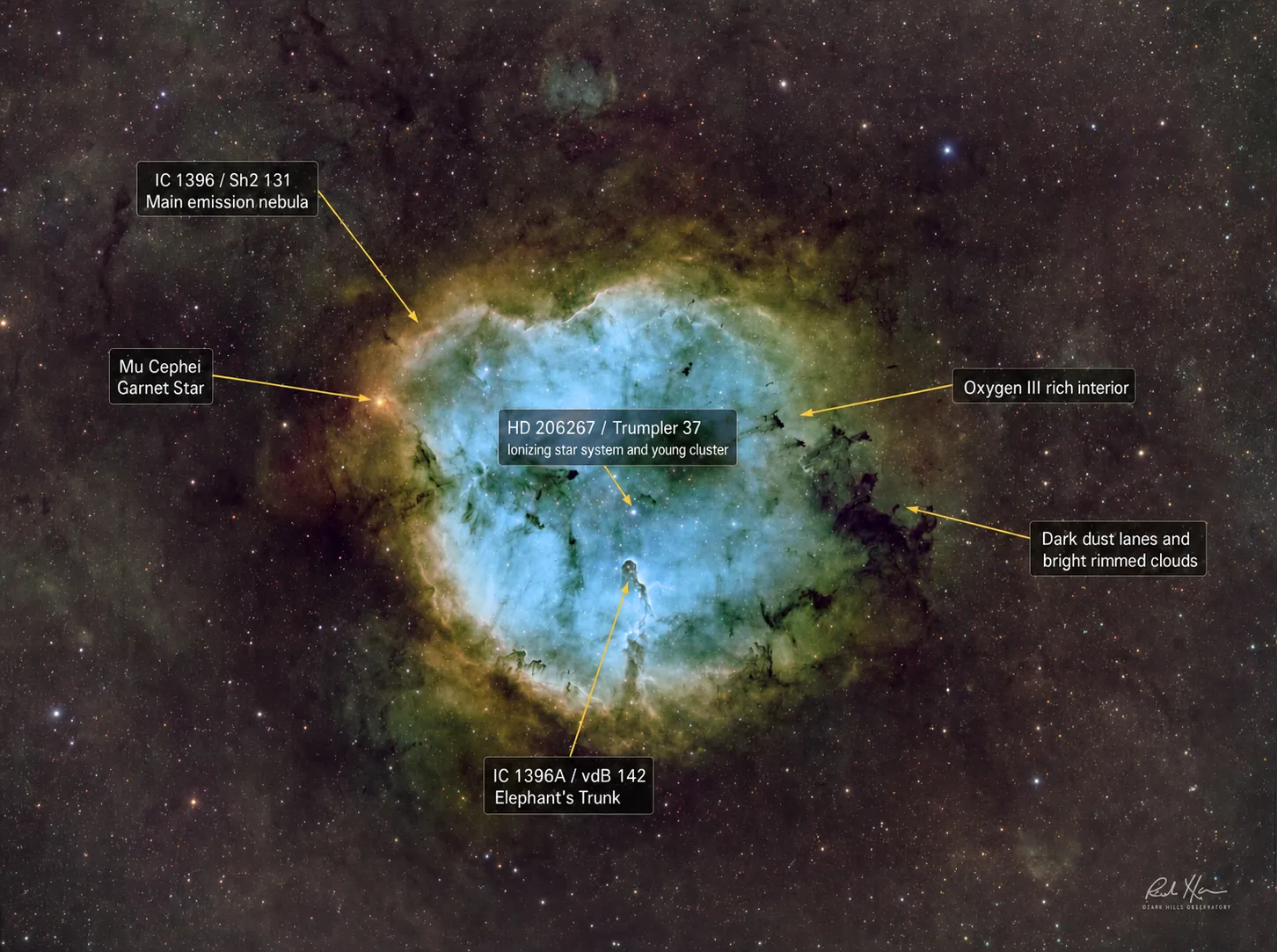
This field contains much more than the Elephant’s Trunk. The most important features to call out are:
-
IC 1396, also cataloged as Sh2 131, fills most of the frame. The large irregular outline marks the main ionized hydrogen region.
-
The Elephant’s Trunk, or IC 1396A, sits in the lower middle. vdB 142 identifies the associated reflection and dark nebula around the trunk.
-
Mu Cephei, the Garnet Star, is the bright orange red star in the upper left.
-
HD 206267 is near the central interior of IC 1396. It is the massive multiple star system responsible for ionizing much of the nebula.
-
Trumpler 37, also called Collinder 439, occupies the central stellar region around HD 206267. It is a young, loose cluster associated with the nebula.
-
Barnard dark nebulae include B 160, B 162, B 365, B 367, and B 368. These are some of the larger dark dust structures crossing the field.
-
Lynds dark nebulae appear throughout the frame. The more prominent entries include LDN 1083, 1085, 1086, 1087, 1088, 1092, 1093, 1096, 1098, 1099, 1101, 1102, 1105, 1106, 1110, 1112, 1114, 1115, 1116, 1117, 1118, 1120, 1123, 1124, 1126, 1127, 1128, 1129, 1130, 1132, 1138, 1139, and 1141.
More Than a Red Nebula
Many photographs of the Elephant’s Trunk are almost entirely red - or heavly slanted green. Others use the traditional SHO palette and show large portions of the nebula in green. Those are legitimate processing choices, but I believe they can misrepresent the complexity of the region.
The data does not show one gas spread evenly across the frame. It shows hydrogen, sulfur, and oxygen occupying different areas and mixing in different proportions. If all of that information is forced into a mostly red or green presentation, some of the physical structure becomes harder to see.
No narrowband image is literal visual color. We are assigning visible colors to wavelengths our eyes cannot separate when looking through a telescope. Still, the way those colors are assigned can either reveal the data or bury it. My goal was to let the different emissions remain distinct enough that the viewer can see what is actually happening.
Processing IC 1396 and the Elephant’s Trunk Nebula
This image was captured with the ZWO ASI461MM Pro, a medium format monochrome astronomy camera that is still relatively uncommon among amateur astrophotographers. Its 100 megapixel sensor records an enormous field while retaining very fine detail. That combination makes a real difference with a large object like IC 1396.
Of course, a large sensor does not do the work for you. It gives you more data, including more opportunities to find problems. Focus, tracking, sensor tilt, filter alignment, calibration, and field correction all have to be right across the entire frame. Small errors that might hide near the edge of a smaller sensor have nowhere to hide here.
The finished image uses a hybrid Foraxx style palette in which I blend RGB data with hydrogen, sulfur, and oxygen narrowband data. The RGB provides natural star color and a familiar foundation. The SHO data brings out the contrast and separates structures that would otherwise blend together.
This is not a quick process. Each channel has to be calibrated, aligned, balanced, and blended without allowing one signal to overwhelm the others. There is a lot of moving back and forth, making small adjustments, and occasionally undoing something that looked like a good idea twenty minutes earlier. That is simply part of the work.
The Structure Inside the Data
Download the full resolution 100 megapixel JPEG
Please note that the compressed file is over 130 MB.
An uncompressed TIFF version is available upon request for research or high quality printing.
The blue center is primarily the oxygen signal. It sits inside a much larger ring of hydrogen mixed with sulfur and additional oxygen. The Elephant’s Trunk rises from that surrounding ring as a dense column of material being shaped by radiation from nearby stars.
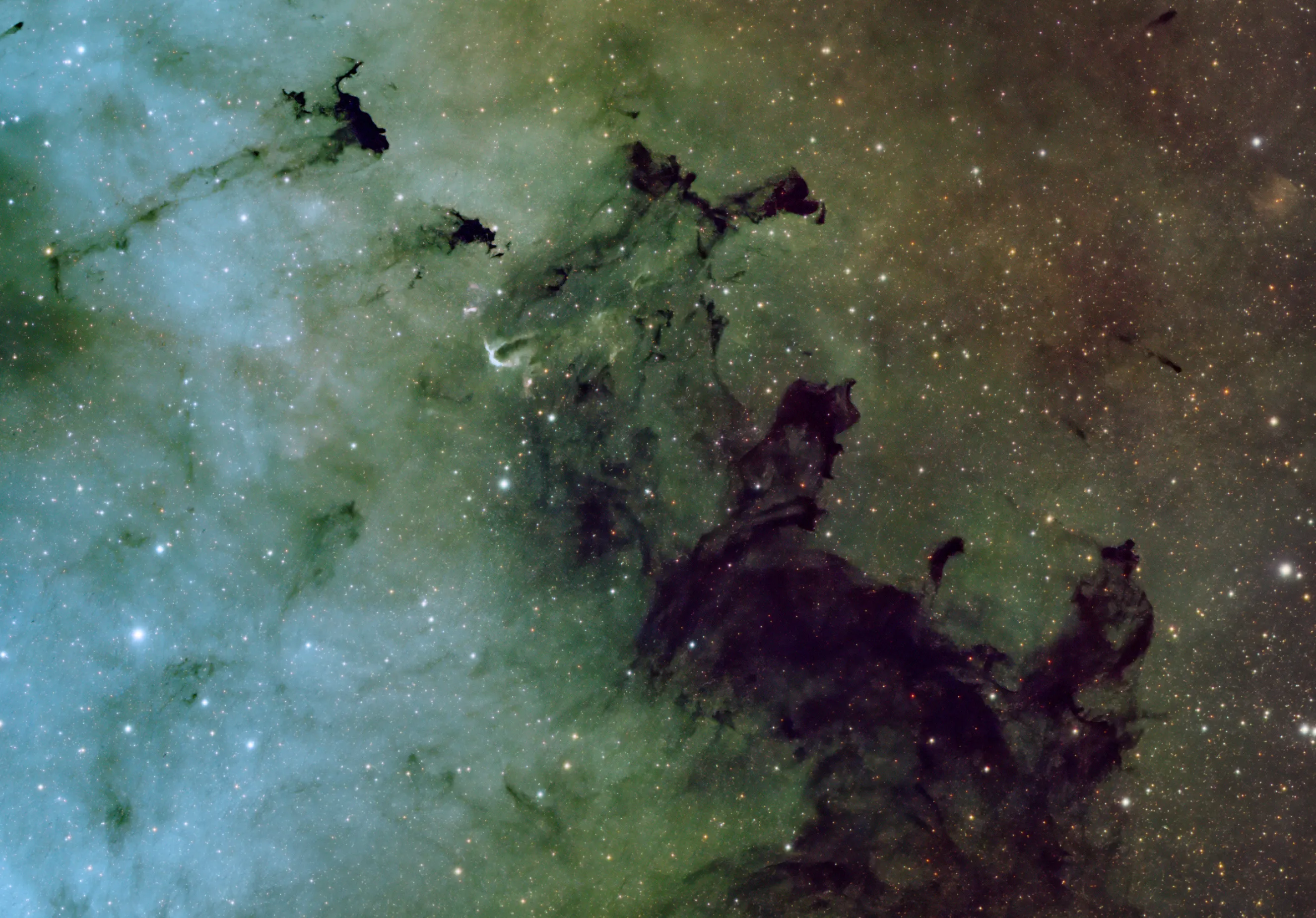
Then there are the dark dust veins running throughout the photograph. They are not empty gaps in the nebula. They are thick lanes of cooler dust and gas blocking the light behind them. Some are broad and obvious. Others are thin enough to resemble cracks running through the brighter emission.
Those dark structures are important because they give the region depth. Without them, IC 1396 can look like a fairly uniform cloud. With enough data and careful processing, it becomes clear that this is a layered environment filled with ridges, cavities, knots, and dense material.
That is the part of astrophotography I enjoy most. The camera collects photons, but the real job is learning what those photons are telling us. Processing should not be about making the loudest picture possible. It should be about bringing forward the information that was already there.
This photograph took a considerable amount of time to capture and process. It was difficult, and there were plenty of places where it could have gone wrong. But when the final image begins to show the hydrogen ring, the oxygen center, the sulfur woven through the structure, and those dark dust veins crossing the field, the time no longer seems unreasonable.
The results are worth the work. Final result is below.
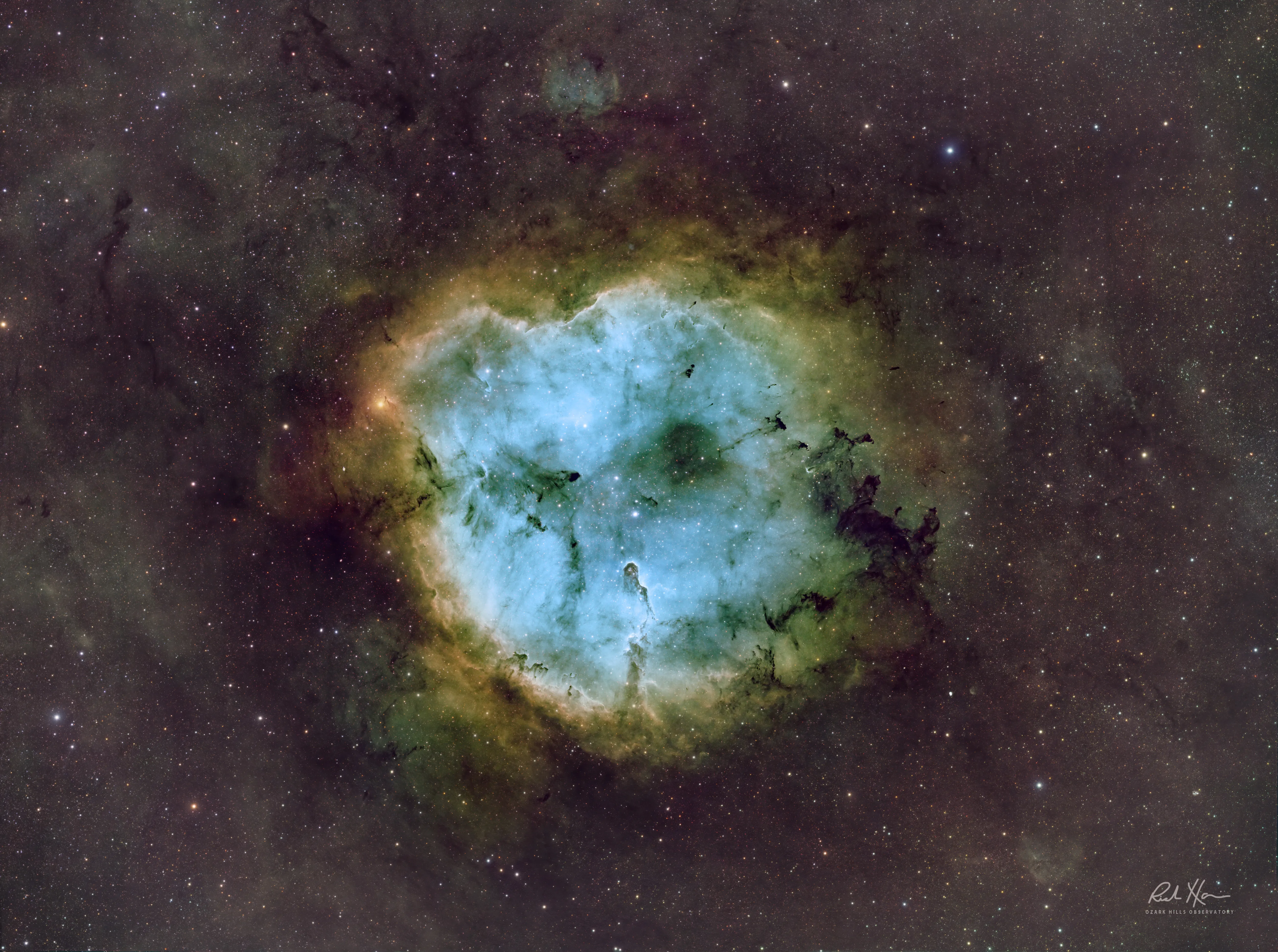
IC 1396 and the Elephant’s Trunk Nebula Wide Field Complex
Astrophotographer: Richard Harris
Object: IC 1396, Sh2 131, IC 1396A Elephant’s Trunk Nebula, vdB 142, Trumpler 37, HD 206267, Mu Cephei, surrounding bright rimmed clouds, and dark nebulae
Date: July 21st, 2026
Location: Strafford, Missouri, USA
Telescope: Takahashi FSQ-106EDX4 with 0.72× 645 Reducer (380mm, f/3.6)
Mount: ZWO AM7 harmonic drive mount
Camera: ZWO ASI461MM Pro medium format monochrome camera, Gain 0
Filters: Chroma RGB and 3nm SHO filters
Guide Scope: William Optics 50mm
Guide Camera: ZWO ASI290MM Mini
Guiding: Approximately 0.28–0.50 arcseconds RMS
Controller: ZWO ASIAIR
Pier: Astro TUFF TRUK Pier
Acquisition:
Sulfur II: 60 frames at 300 seconds = 5 hours
Hydrogen alpha: 60 frames at 300 seconds = 5 hours
Oxygen III: 60 frames at 300 seconds = 5 hours
RGB integration: 2 hours
Total Acquisition Time: 17 hours
Calibration Frames: None
Processing: PixInsight and Photoshop using a hybrid RGB, SHO, and Foraxx style palette
Bortle Class Skies: 3 - 4
IC 1396, the Bible, and the Limits of Observation
“The heavens declare the glory of God; and the firmament sheweth his handywork.”
When I look at IC 1396, I see more than hydrogen, sulfur, oxygen, stars, and dark dust. I see an ordered creation that existed before our telescopes, cameras, mathematical models, or explanations of it.
Astronomers currently estimate that IC 1396 is approximately 2,400 light years from Earth. That is a useful scientific estimate, but it is still an inference made from our fixed observational position. We did not watch the light leave the nebula, follow it across space, and measure the entire journey. We receive the light here and now, measure what reaches us, and interpret it through the best methods presently available.
That distinction is important to me.
The Harris Paradox considers the tension created when we draw universal conclusions about the universe from one location inside it. Cosmology studies a single system that we cannot reproduce, observe from the outside, or experience across its full scale. Our models may be useful and remarkably effective, but they should not be confused with an unrestricted view of reality.
This does not require rejecting science. It requires humility about what science can establish through direct observation and what must be reconstructed through inference.
The colors in this photograph were produced by mapping the recorded emissions of hydrogen, sulfur, and oxygen into a visible image. The colors have been processed, but the light and structure recorded by the camera are real. What we conclude about their complete history depends upon assumptions concerning distance, time, motion, and the behavior of light across scales no human being can directly experience.
Science helps us study what we can observe. Scripture reminds me that creation has meaning beyond what we can measure.
The more carefully I photograph a region like IC 1396, the more appropriate Psalm 19 becomes. The heavens do not need to explain every mechanism to us before they can declare the glory of their Creator. Their scale, order, complexity, and our remarkable ability to observe them already say a great deal.
About the Author
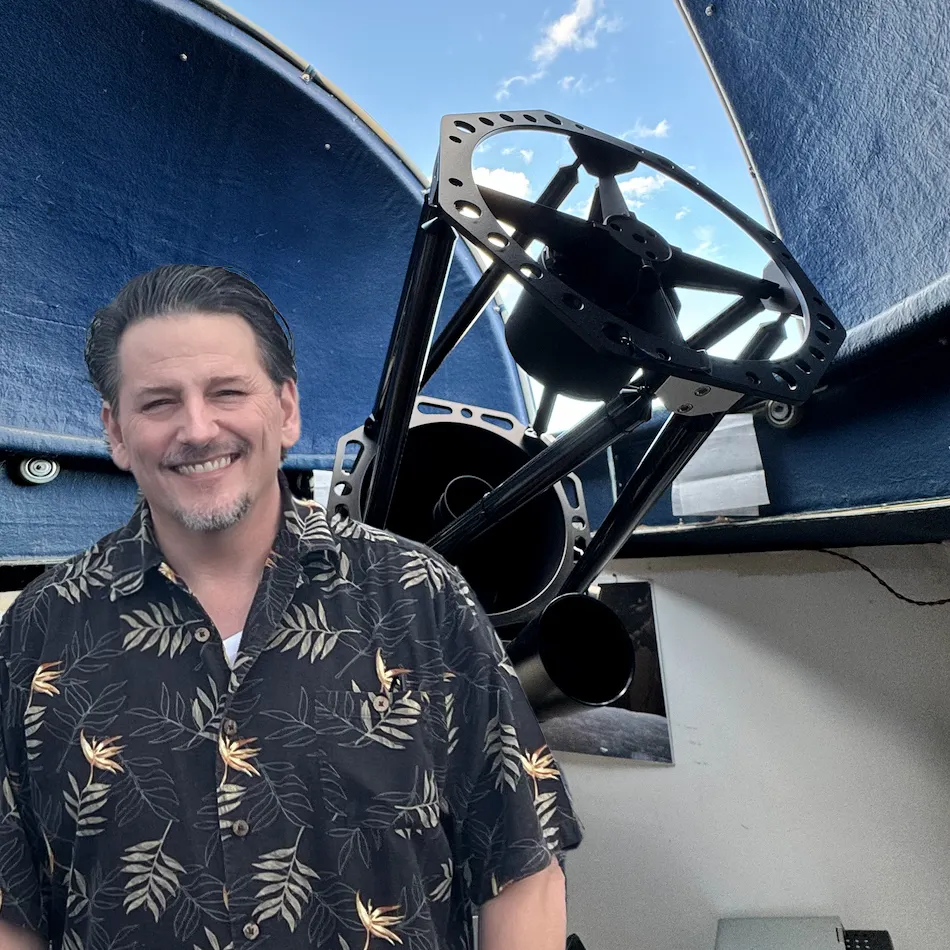
Meet Richard Harris. He is the founder and editor-in-chief of ScopeTrader, with over 40 years of experience in observational astronomy and astrophotography. He serves as the director of the Ozark Hills Observatory, where his research and imagery have been featured in scientific textbooks, academic publications, and educational media. Among his theoretical contributions is a cosmological proposition known as The Harris Paradox, which explores deep-field observational symmetry and time-invariant structures in cosmic evolution. A committed citizen scientist, Harris is actively involved with the Springfield Astronomical Society, the Amateur Astronomers Association, the Astronomical League, and the International Dark-Sky Association. He is a strong advocate for reducing light pollution and enhancing public understanding of the cosmos. In 2001, Harris developed the German Equatorial HyperTune - a precision mechanical enhancement for equatorial telescope mounts that has since become a global standard among amateur and professional astronomers seeking improved tracking and imaging performance. Beyond the observatory, Harris is a serial entrepreneur and founder of several tech-based ventures. Driven by both scientific curiosity and creative innovation, Harris continues to blend the frontiers of astronomy and technology, inspiring others to explore the universe and rethink the possibilities within it. When he's not taking photos of our universe, you can find him with family, playing guitar, or traveling.